

Is Fannie Mae Ever Going To Make Money
 | |
| Type | Government-sponsored enterprise and public company |
|---|---|
| Traded as | OTCQB: FNMA |
| Industry | Fiscal services |
| Founded | 1938 (1938) |
| Headquarters | 1100 15th St NW, Washington, D.C. |
| Key people |
|
| Products | Mortgage-backed securities |
| Revenue |  US$120.2 billion (2019) US$120.2 billion (2019) |
| Operating income |  US$17.6 billion (2019) US$17.6 billion (2019) |
| Net income | US$14.2 billion (2019) |
| Total assets | Us$iii.v trillion(2019) |
| Total equity | −U.s.$fourteen,608 million (2019) |
| Number of employees | ~seven,500 (2019) |
| Website | fanniemae |
| Footnotes / references https://www.fanniemae.com/resources/file/ir/pdf/quarterly-annual-results/2019/q42019.pdf | |
The Federal National Mortgage Association (FNMA), commonly known as Fannie Mae, is a United States government-sponsored enterprise (GSE) and, since 1968, a publicly traded visitor. Founded in 1938 during the Slap-up Low equally part of the New Bargain,[ii] the corporation'due south purpose is to aggrandize the secondary mortgage market by securitizing mortgage loans in the form of mortgage-backed securities (MBS),[3] allowing lenders to reinvest their avails into more than lending and in effect increasing the number of lenders in the mortgage market by reducing the reliance on locally based savings and loan associations (or "thrifts").[four] Its blood brother organization is the Federal Home Loan Mortgage Corporation (FHLMC), amend known as Freddie Mac. As of 2018, Fannie Mae is ranked number 21 on the Fortune 500 rankings of the largest United States corporations past total acquirement.[5]
History [edit]
Background and early decades [edit]
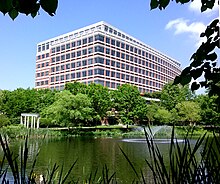
A view, from the southwest, of the Federal National Mortgage Association's (Fannie Mae'southward) Reston, Virginia facility.
Historically, nigh housing loans in the early 1900s in the USA were short term mortgage loans with balloon payments.[6] The Bang-up Depression wrought havoc on the U.S. housing marketplace as people lost their jobs and were unable to make payments. Past 1933, an estimated 20 to 25% of the nation's outstanding mortgage debt was in default.[seven] This resulted in foreclosures in which virtually 25% of America's homeowners lost their homes to banks. To address this, Fannie Mae was established past the U.S. Congress in 1938 past amendments to the National Housing Act[8] as part of Franklin Delano Roosevelt's New Deal. Originally chartered as the National Mortgage Clan of Washington, the organization's explicit purpose was to provide local banks with federal money to finance home loans in an endeavour to heighten levels of home ownership and the availability of affordable housing.[ix] Fannie Mae created a liquid secondary mortgage market and thereby fabricated it possible for banks and other loan originators to result more housing loans, primarily by buying Federal Housing Administration (FHA) insured mortgages.[x] For the offset thirty years following its inception, Fannie Mae held a monopoly over the secondary mortgage market.[9] Other considerations may have motivated the New Deal focus on the housing marketplace: near a 3rd of the nation's unemployed were in the building merchandise, and the authorities had a vested interest in getting them back to work by giving them homes to build.[eleven]
Fannie Mae was acquired by the Housing and Home Finance Agency from the Federal Loan Agency as a constituent unit in 1950.[12] In 1954, an amendment known as the Federal National Mortgage Clan Lease Act[thirteen] fabricated Fannie Mae into "mixed-ownership corporation", meaning that federal government held the preferred stock while private investors held the common stock;[8] in 1968 it converted to a privately held corporation, to remove its activeness and debt from the federal budget.[14] In the 1968 change, arising from the Housing and Urban Development Act of 1968, Fannie Mae's predecessor (likewise called Fannie Mae) was split into the electric current Fannie Mae and the Government National Mortgage Association ("Ginnie Mae").
Ginnie Mae, which remained a government organization, guarantees FHA-insured mortgage loans as well as Veterans Administration (VA) and Farmers Dwelling house Administration (FmHA) insured mortgages. As such, Ginnie Mae is the only home-loan agency explicitly backed by the total religion and credit of the United States government.[15]
In 1970, the federal government authorized Fannie Mae to purchase conventional loans, i.east. those non insured by the FHA, VA, or FmHA, and created the Federal Home Loan Mortgage Corporation (FHLMC), colloquially known equally Freddie Mac, to compete with Fannie Mae and thus facilitate a more robust and efficient secondary mortgage market place.[15] That same year FNMA went public on New York and Pacific Exchanges.[xvi]
In 1981, Fannie Mae issued its beginning mortgage passthrough and called it a mortgage-backed security. Ginnie Mae had guaranteed the first mortgage passthrough security of an approved lender in 1968[17] and in 1971 Freddie Mac issued its first mortgage passthrough, called a participation certificate, composed primarily of private mortgage loans.[17]
1990s [edit]

Fannie Mae's former headquarters at 3900 Wisconsin Avenue NW in Washington, D.C.
In 1992, President George H.W. Bush signed the Housing and Community Development Deed of 1992.[18] The Act amended the charter of Fannie Mae and Freddie Mac to reflect the Democratic Congress' view that the GSEs "take an affirmative obligation to facilitate the financing of affordable housing for low- and moderate-income families in a manner consequent with their overall public purposes, while maintaining a strong fiscal condition and a reasonable economic return".[19] For the first fourth dimension, the GSEs were required to run into "affordable housing goals" gear up annually by the Department of Housing and Urban Development (HUD) and approved by Congress. The initial annual goal for low-income and moderate-income mortgage purchases for each GSE was xxx% of the total number of dwelling units financed past mortgage purchases[20] and increased to 55% by 2007.
In 1999, Fannie Mae came under pressure from the Clinton administration to expand mortgage loans to low and moderate income borrowers by increasing the ratios of their loan portfolios in distressed inner city areas designated in the Community Reinvestment Human activity (CRA) of 1977.[21] In 1999, The New York Times reported that with the corporation'south move towards the subprime market "Fannie Mae is taking on significantly more take a chance, which may not pose whatever difficulties during flush economic times. Merely the government-subsidized corporation may encounter trouble in an economic downturn, prompting a government rescue like to that of the savings and loan manufacture in the 1980s."[22]
2000s [edit]

Franklin Raines earned $90 million in salary and bonuses while he was head of Fannie Mae.[23]
In 2000, because of a re-assessment of the housing market past HUD, anti-predatory lending rules were put into place that disallowed risky, high-cost loans from being credited toward affordable housing goals. In 2004, these rules were dropped and loftier-risk loans were again counted toward affordable housing goals.[24]
The intent was that Fannie Mae'southward enforcement of the underwriting standards they maintained for standard conforming mortgages would as well provide safe and stable means of lending to buyers who did not have prime credit. Every bit Daniel Mudd, then president and CEO of Fannie Mae, testified in 2007, instead the bureau's underwriting requirements drove concern into the arms of the private mortgage industry who marketed ambitious products without regard to future consequences:
We also set conservative underwriting standards for loans nosotros finance to ensure the homebuyers can afford their loans over the long term. We sought to bring the standards we apply to the prime number infinite to the subprime market with our industry partners primarily to aggrandize our services to underserved families. Unfortunately, Fannie Mae-quality, safe loans in the subprime market place did not become the standard, and the lending market moved away from us. Borrowers were offered a range of loans that layered teaser rates, interest-merely, negative amortization and payment options and low-documentation requirements on top of floating-rate loans. In early 2005 nosotros began sounding our concerns about this "layered-risk" lending. For case, Tom Lund, the head of our unmarried-family mortgage concern, publicly stated, "One of the things we don't feel skilful almost right now as we wait into this marketplace is more than homebuyers being put into programs that have more run a risk. Those products are for more sophisticated buyers. Does it make sense for borrowers to take on risk they may not be aware of? Are nosotros setting them upward for failure? Every bit a result, we gave upwardly significant marketplace share to our competitors."[25]
Alex Berenson of The New York Times reported in 2003 that Fannie Mae's risk was much larger than was unremarkably believed.[26] Nassim Taleb wrote in The Blackness Swan: "The government-sponsored institution Fannie Mae, when I expect at its risks, seems to be sitting on a butt of dynamite, vulnerable to the slightest hiccup. Merely not to worry: their large staff of scientists deem these events 'unlikely'".[27]
On Jan 26, 2005, the Federal Housing Enterprise Regulatory Reform Deed of 2005 (Southward.190) was first introduced in the Senate past Sen. Chuck Hagel.[28] The Senate legislation was an effort to reform the existing GSE regulatory structure in light of the recent bookkeeping problems and questionable management actions leading to considerable income restatements by the GSEs. After being reported favorably past the Senate's Committee on Banking, Housing, and Urban Diplomacy in July 2005, the bill was never considered by the full Senate for a vote.[29] Sen. John McCain's decision to become a cosponsor of S.190 almost a year later in 2006 was the concluding action taken regarding Sen. Hagel's bill in spite of developments since clearing the Senate Committee. Sen. McCain pointed out that Fannie Mae's regulator reported that profits were "illusions deliberately and systematically created by the company's senior direction" in his floor statement giving support to S.190.[xxx] [31]
At the same time, the House also introduced similar legislation, the Federal Housing Finance Reform Human action of 2005 (H.R. 1461), in the Jump of 2005. The Firm Financial Services Commission had crafted changes and produced a Committee Written report by July 2005 to the legislation. It was passed past the House in October in spite of President Bush's statement of policy opposed to the House version, which stated: "The regulatory regime envisioned by H.R. 1461 is considerably weaker than that which governs other large, complex financial institutions."[32] The legislation met with opposition from both Democrats and Republicans at that point and the Senate never took up the House passed version for consideration afterward that.[33]
The mortgage crisis from late 2007 [edit]
Following their mission to meet federal Housing and Urban Evolution (HUD) housing goals, GSEs such as Fannie Mae, Freddie Mac and the Federal Home Loan Banks (FHLBanks) had striven to improve home buying of depression and heart income families, underserved areas, and generally through special affordable methods such equally "the ability to obtain a 30-year fixed-rate mortgage with a low down payment ... and the continuous availability of mortgage credit under a wide range of economic conditions".[34] Then in 2003–2004, the subprime mortgage crisis began.[35] The market shifted away from regulated GSEs and radically toward Mortgage Backed Securities (MBS) issued by unregulated private-label securitization (PLS) conduits, typically operated by investment banks.
As loan originators began to distribute more and more of their loans through individual label PLS's, the GSEs lost the ability to monitor and command loan originators. Competition between the GSEs and private securitizers for loans further undermined GSEs' power and strengthened mortgage originators. This contributed to a reject in underwriting standards and was a major cause of the financial crisis.
Investment banking company securitizers were more willing to securitize risky loans considering they by and large retained minimal hazard. Whereas the GSEs guaranteed the functioning of their mortgage-backed securities (MBSs), individual securitizers mostly did not, and might only retain a thin slice of risk. Oft, banks would offload this risk to insurance companies or other counterparties through credit default swaps, making their actual risk exposures extremely difficult for investors and creditors to discern.
The shift toward riskier mortgages and private label MBS distribution occurred as financial institutions sought to maintain earnings levels that had been elevated during 2001–2003 by an unprecedented refinancing boom due to historically low interest rates. Earnings depended on book, so maintaining elevated earnings levels necessitated expanding the borrower puddle using lower underwriting standards and new products that the GSEs would not (initially) securitize. Thus, the shift away from GSE securitization to private-label securitization (PLS) also corresponded with a shift in mortgage product type, from traditional, amortizing, stock-still-charge per unit mortgages (FRMs) to nontraditional, structurally riskier, nonamortizing, adjustable-rate mortgages (ARM'southward), and in the kickoff of a precipitous deterioration in mortgage underwriting standards.[35] The growth of PLS, however, forced the GSEs to lower their underwriting standards in an effort to reclaim lost market share to please their private shareholders. Shareholder pressure pushed the GSEs into competition with PLS for market place share, and the GSEs loosened their guarantee business underwriting standards in social club to compete. In contrast, the wholly public FHA/Ginnie Mae maintained their underwriting standards and instead ceded market share.[35]
The growth of individual-label securitization and lack of regulation in this part of the market resulted in the crowd of underpriced housing finance[35] that led, in 2006, to an increasing number of borrowers, often with poor credit, who were unable to pay their mortgages – peculiarly with adaptable rate mortgage loans (ARM), caused a precipitous increase in habitation foreclosures. Every bit a result, abode prices declined as increasing foreclosures added to the already large inventory of homes and stricter lending standards made information technology more and more difficult for borrowers to get loans. This depreciation in home prices led to growing losses for the GSEs, which back the majority of Us mortgages. In July 2008, the authorities attempted to ease market fears past reiterating their view that "Fannie Mae and Freddie Mac play a key role in the U.s.a. housing finance organization". The U.s.a. Treasury Department and the Federal Reserve took steps to eternalize confidence in the corporations, including granting both corporations access to Federal Reserve low-involvement loans (at like rates every bit commercial banks) and removing the prohibition on the Treasury Department to purchase the GSEs' stock. Despite these efforts, by August 2008, shares of both Fannie Mae and Freddie Mac had tumbled more than 90% from their one-twelvemonth prior levels.
On October 21, 2010, FHFA estimates revealed that the bailout of Freddie Mac and Fannie Mae will probable price taxpayers $224–360 billion in total, with over $150 billion already provided.[36]
2008 – crisis and conservatorship [edit]
On July 11, 2008, The New York Times reported that U.South. regime officials were because a plan for the U.S. government to accept over Fannie Mae and/or Freddie Mac should their fiscal situations worsen due to the U.South. housing crisis.[37] Fannie Mae and smaller Freddie Mac owned or guaranteed a massive proportion of all home loans in the United States and and so were specially hard striking by the slump.[ commendation needed ] The government officials also stated that the government had too considered calling for explicit government guarantee through legislation of $5 trillion on debt owned or guaranteed past the two companies.[ citation needed ]
Fannie stock plunged.[38] Some worried that Fannie lacked majuscule and might go bankrupt. Others worried most a government seizure. U.S. Treasury Secretary Henry M. Paulson equally well as the White Business firm went on the air to defend the financial soundness of Fannie Mae, in a concluding-ditch attempt to prevent a total fiscal panic.[39] [40] Fannie and Freddie underpinned the whole U.Due south. mortgage market. As recently every bit 2008, Fannie Mae and the Federal Home Loan Mortgage Corporation (Freddie Mac) had owned or guaranteed virtually half of the U.Southward.'s $12 trillion mortgage market place.[37] If they were to collapse, mortgages would be harder to obtain and much more expensive. Fannie and Freddie bonds were owned by anybody from the Chinese Regime, to money market funds, to the retirement funds of hundreds of millions of people. If they went bankrupt there would be mass upheaval on a global scale.[41]
The Administration PR endeavor was non enough, by itself, to salvage the GSEs. Their regime directive to purchase bad loans from private banks, in order to prevent these banks from declining, equally well as the 20 top banks falsely classifying loans equally AAA, caused instability. Paulson'due south plan was to go in swiftly and seize the two GSEs, rather than provide loans as he did for AIG and the major banks; he told president Bush that "the first sound they hear will be their heads hitting the floor", in a reference to the French revolution.[41] The major banks have since been sued by the Feds for a sum of $200,000,000, and some of the major banks have already settled.[42] In addition, a lawsuit has been filed confronting the federal government by the shareholders of Fannie Mae and Freddie Mac, for a) creating an environment by which Fannie and Freddie would be unable to meet their financial obligations b) forcing the executive management to sign over the companies to the conservator by (a), and c) the gross violation of the (fifth amendment) taking clause.
On September 7, 2008, James Lockhart, manager of the Federal Housing Finance Agency (FHFA), announced that Fannie Mae and Freddie Mac were being placed into conservatorship of the FHFA. The action was "one of the most sweeping authorities interventions in individual financial markets in decades".[43] [44] [45] Lockhart also dismissed the firms' primary executive officers and boards of directors, and caused the issuance to the Treasury new senior preferred stock and common stock warrants amounting to 79.nine% of each GSE. The value of the common stock and preferred stock to pre-conservatorship holders was greatly diminished by the interruption of future dividends on previously outstanding stock, in the endeavor to maintain the value of company debt and of mortgage-backed securities. FHFA stated that there are no plans to liquidate the visitor.[43] [44] [45] [46] [47] [48] [49]
The authority of the U.S. Treasury to advance funds for the purpose of stabilizing Fannie Mae, or Freddie Mac is limited just by the amount of debt that the entire federal authorities is permitted past law to commit to. The July 30, 2008, law enabling expanded regulatory potency over Fannie Mae and Freddie Mac increased the national debt ceiling US$800 billion, to a total of Usa$10.7 Trillion in apprehension of the potential demand for the Treasury to have the flexibility to support the federal home loan banks.[l] [51] [52]
2010 – delisting [edit]
On June 16, 2010, Fannie Mae and Freddie Mac announced their stocks would be delisted from the NYSE. The Federal Housing Finance Agency directed the delisting afterwards Fannie's stock traded beneath $1 a share for over 30 days. Since then the stocks take continued to merchandise on the Over-the-Counter Bulletin Board.[53]
Dividends paid to regime [edit]
In May 2013, Fannie Mae announced that information technology is going to pay a dividend of $59.4 billion to the United States Treasury.[54]
In 2014, gross flows were:
- $116 billion received from Treasury[55]
- $134 billion paid to Treasury[56]
Fannie Mae's 2014 financial results enabled it to pay $20.six billion in dividends to Treasury for the year, resulting in a cumulative total of $134.5 billion in dividends through December 31, 2014 – approximately $18 billion more than Fannie Mae received in support. As of March 31, 2015, Fannie Mae expects to have paid a total of $136.4 billion in payments to the Treasury.[57] [58] [59] [sixty]
Business [edit]
Fannie Mae makes money partly by borrowing at depression rates, and then reinvesting its borrowings into whole mortgage loans and mortgage backed securities. It borrows in the debt markets by selling bonds, and provides liquidity to loan originators by purchasing whole loans. It purchases whole loans and then securitizes them for the investment market by creating MBS that are either retained or sold.
Equally a Authorities Sponsored Enterprise, or GSE, Fannie Mae is compelled by constabulary to provide liquidity to loan originators in all economic conditions. Information technology must legally ignore adverse market conditions which appear to exist unprofitable. If in that location are loans available for purchase that run across its predetermined underwriting standards, it must purchase them if no other buyers are available. Because of the size, scale, and telescopic of the United states single-family residential and commercial residential markets, market place participants viewed Fannie Mae corporate debt as having a very loftier probability of being repaid. Fannie Mae is able to borrow very inexpensively in the debt markets as a consequence of market place perception. At that place usually exists a large difference between the rate at which information technology tin can borrow and the rate at which it can 'lend'. This was called "The big, fat gap" by Alan Greenspan.[61] Past August 2008, Fannie Mae's mortgage portfolio was in excess of $700 billion.
Fannie Mae also earns a significant portion of its income from guaranty fees information technology receives as compensation for assuming the credit chance on mortgage loans underlying its unmarried-family Fannie Mae MBS and on the single-family mortgage loans held in its retained portfolio. Investors, or purchasers of Fannie Mae MBSs, are willing to let Fannie Mae go on this fee in commutation for assuming the credit gamble; that is, Fannie Mae'south guarantee that the scheduled primary and interest on the underlying loan will be paid fifty-fifty if the borrower defaults.
Fannie Mae's charter has historically prevented it from guaranteeing loans with a loan-to-values over fourscore% without mortgage insurance or a repurchase agreement with the lender;[8] still, in 2006 and 2007 Fannie Mae did purchase subprime and Alt-A loans every bit investments.[62]
Business concern machinery [edit]

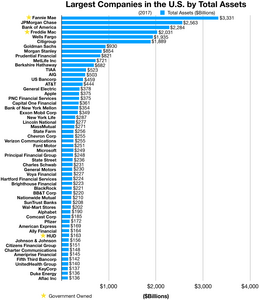
Fannie Mae is a purchaser of mortgages loans and the mortgages that secure them, which it packages into mortgaged-backed securities (MBS). Fannie Mae buys loans from approved mortgage sellers and securitizes them; information technology then sells the resultant mortgage-backed security to investors in the secondary mortgage marketplace, along with a guarantee that the stated main and interest payments will be timely passed through to the investor.[ commendation needed ]. In addition, Fannie MBS, like those of Freddie Mac MBS and Ginnie Mae MBS, are eligible to be traded in the "to-be-announced" or "TBA" market.[63] Past purchasing the mortgages, Fannie Mae and Freddie Mac provide banks and other fiscal institutions with fresh coin to make new loans. This gives the Usa housing and credit markets flexibility and liquidity.[64]
In guild for Fannie Mae to provide its guarantee to mortgage-backed securities it bug, it sets the guidelines for the loans that it will take for buy, chosen "conforming" loans. Fannie Mae produced an automated underwriting organization (AUS) tool called Desktop Underwriter (DU) which lenders can utilize to automatically make up one's mind if a loan is befitting; Fannie Mae followed this programme up in 2004 with Custom DU, which allows lenders to set custom underwriting rules to handle nonconforming loans every bit well.[65] The secondary market for nonconforming loans includes colossal loans, which are loans larger than the maximum that Fannie Mae and Freddie Mac volition purchase. In early on 2008, the decision was made to let TBA (To-be-announced)-eligible mortgage-backed securities to include upwards to x% "jumbo" loans.[66]
Conforming loans [edit]
Fannie Mae and Freddie Mac accept a limit on the maximum sized loan they volition guarantee. This is known as the "conforming loan limit". The conforming loan limit for Fannie Mae, along with Freddie Mac, is set up by Office of Federal Housing Enterprise Oversight (OFHEO), the regulator of both GSEs. OFHEO annually sets the limit of the size of a conforming loan based on the October to October changes in hateful home toll, to a higher place which a mortgage is considered a non-befitting jumbo loan. The conforming loan limit is fifty percent higher in Alaska and Hawaii. The GSEs only purchase loans that are conforming to repackage into the secondary market, lowering the need for non-conforming loans. Past virtue of the law of supply and demand, so, information technology is harder for lenders to sell these loans in the secondary market place; thus these types of loans tend to cost more to borrowers (typically 1/4 to 1/2 of a per centum). Indeed, in 2008, since the demand for bonds non guaranteed by GSEs was about non-real, non-conforming loans were priced nearly 1% to 1.5% higher than conforming loans.
Implicit guarantee and authorities support [edit]
Originally, Fannie had an 'explicit guarantee' from the government; if information technology got in trouble, the government promised to bail it out. This changed in 1968. Ginnie Mae was separate off from Fannie. Ginnie retained the explicit guarantee. Fannie, however, became a individual corporation, chartered by Congress and with a direct line of credit to the US Treasury. It was its nature as a Authorities Sponsored Enterprise (GSE) that provided the 'implied guarantee' for their borrowing. The charter also limited their concern activeness to the mortgage marketplace. In this regard, although they were a individual company, they could not operate like a regular private company.
Fannie Mae received no direct government funding or backing; Fannie Mae securities carried no actual explicit authorities guarantee of being repaid. This was clearly stated in the law that authorizes GSEs, on the securities themselves, and in many public communications issued by Fannie Mae.[ commendation needed ] Neither the certificates nor payments of principal and involvement on the certificates were explicitly guaranteed past the United states of america government. The certificates did non legally institute a debt or obligation of the United states of america or whatever of its agencies or instrumentalities other than Fannie Mae. During the sub-prime era, every Fannie Mae prospectus read in assuming, all-caps letters: "The certificates and payments of principal and interest on the certificates are not guaranteed by the United States, and do not constitute a debt or obligation of the United States or whatsoever of its agencies or instrumentalities other than Fannie Mae." (Circumlocution changed from all-caps to standard case for readability).[ commendation needed ] [67]
However, the unsaid guarantee, as well as various special treatments given to Fannie by the regime, greatly enhanced its success.
For example, the implied guarantee allowed Fannie Mae and Freddie Mac to save billions in borrowing costs, as their credit rating was very good. Estimates past the Congressional Budget Office and the Treasury Department put the effigy at near $ii billion per yr.[68] Vernon 50. Smith, recipient of the Sveriges Riksbank Prize in Economic Sciences, has called FHLMC and FNMA "implicitly taxpayer-backed agencies".[69] The Economist has referred to "the implicit government guarantee"[70] of FHLMC and FNMA. In testimony before the House and Senate Banking Committee in 2004, Alan Greenspan expressed the belief that Fannie Mae's (weak) fiscal position was the result of markets believing that the U.South. Government would never allow Fannie Mae (or Freddie Mac) to neglect.[71]
Fannie Mae and Freddie Mac were allowed to agree less capital letter than normal financial institutions: e.g., they were allowed to sell mortgage-backed securities with only half as much capital backing them up as would be required of other financial institutions. Regulations exist through the FDIC Bank Holding Company Human action that govern the solvency of financial institutions. The regulations crave normal financial institutions to maintain a capital/asset ratio greater than or equal to 3%.[72] The GSEs, Fannie Mae and Freddie Mac, are exempt from this capital/asset ratio requirement and can, and ofttimes do, maintain a majuscule/asset ratio less than 3%. The additional leverage allows for greater returns in skillful times, merely put the companies at greater chance in bad times, such as during the subprime mortgage crisis. FNMA is exempt from state and local taxes, except for certain taxes on existent manor.[73] In add-on, FNMA and FHLMC are exempt from SEC filing requirements; they file SEC 10-Yard and 10-Q reports, but many other reports, such as sure reports regarding their REMIC mortgage securities, are non filed.
Lastly, money market place funds take diversification requirements, so that not more than five% of assets may be from the same issuer. That is, a worst-case default would drop a fund not more than five pct. Yet, these rules practise not apply to Fannie and Freddie. It would not exist unusual to find a fund that had the vast majority of its assets in Fannie and Freddie debt.[ citation needed ]
In 1996, the Congressional Upkeep Office wrote "there accept been no federal appropriations for greenbacks payments or guarantee subsidies. Simply in the place of federal funds the regime provides considerable unpriced benefits to the enterprises ... Government-sponsored enterprises are costly to the government and taxpayers ... the benefit is currently worth $6.five billion annually."[74]
Accounting [edit]
FNMA is a financial corporation which uses derivatives to "hedge" its cash flow. Derivative products it uses include interest charge per unit swaps and options to enter involvement rate swaps ("pay-fixed swaps", "receive-fixed swaps", "basis swaps", "interest charge per unit caps and swaptions", "forward starting swaps"). Duration gap is a financial and accounting term for the difference between the elapsing of assets and liabilities, and is typically used past banks, pension funds, or other financial institutions to measure their adventure due to changes in the interest rate. "The company said that in April its average duration gap widened to plus 3 months in Apr from zero in March." "The Washington-based company aims to go along its duration gap between minus 6 months to plus six months. From September 2003 to March, the gap has run between plus to minus i month."
Controversies [edit]
Bookkeeping controversy [edit]
In belatedly 2004, Fannie Mae was under investigation for its accounting practices. The Office of Federal Housing Enterprise Oversight released a report[75] on September 20, 2004, alleging widespread accounting errors.
Fannie Mae was expected to spend more $1 billion in 2006 solitary to complete its internal inspect and bring it closer to compliance. The necessary restatement was expected to price $10.8 billion, but was completed at a total cost of $6.3 billion in restated earnings as listed in Fannie Mae's Annual Study on Form 10-K.[76]
Concerns with business organization and accounting practices at Fannie Mae predate the scandal itself. On June fifteen, 2000, the House Banking Subcommittee On Capital Markets, Securities And Government-Sponsored Enterprises held hearings on Fannie Mae.[77]
On December 18, 2006, U.S. regulators filed 101 civil charges confronting chief executive Franklin Raines; chief financial officer J. Timothy Howard; and the former controller Leanne One thousand. Spencer. The three were accused of manipulating Fannie Mae earnings to maximize their bonuses. The lawsuit sought to recoup more than than $115 one thousand thousand in bonus payments, collectively accrued by the trio from 1998 to 2004, and most $100 million in penalties for their involvement in the accounting scandal. Afterwards 8 years of litigation, in 2012, a summary judgment was issued immigration the trio, indicating the government had insufficient bear witness that would enable whatsoever jury to find the defendants guilty.[78]
Conflict of interest [edit]
In June 2008, The Wall Street Journal reported that two old CEOs of Fannie Mae, James A. Johnson and Franklin Raines, had received loans below market charge per unit from Countrywide Financial. Fannie Mae was the biggest buyer of Countrywide'southward mortgages.[79] The "Friends of Angelo" VIP Countrywide loan plan included many people from Fannie Mae; lawyers, executives, etc.[lxxx]
Fannie Mae and Freddie Mac have given contributions to lawmakers currently sitting on committees that primarily regulate their industry: The House Financial Services Committee; the Senate Banking, Housing & Urban Affairs Commission; or the Senate Finance Committee.[ citation needed ] The others accept seats on the powerful Appropriations or Ways & Ways committees, are members of the congressional leadership or have run for president.
2011 SEC charges [edit]
| | This section needs to be updated. (September 2021) |

In December 2011, half-dozen Fannie Mae and Freddie Mac executives, including Daniel Mudd, were charged by the U.S. Securities and Exchange Commission with securities fraud.[81] "The SEC alleges they 'knew and approved of' misleading statements claiming the companies had minimal exposure to subprime loans at the superlative of home mortgage bubble."[82] Former Freddie chief fiscal officer Anthony "Buddy" Piszel, who in February 2011, was CFO of CoreLogic, "had received a notice from the SEC that the agency was considering taking action against him". He then resigned from CoreLogic. Piszel was not amid the executives charged in December 2011.[83] Piszel had been succeeded at Freddie by David Kellermann. Kellermann committed suicide during his tenure at Freddie.
A contemporaneous written report on the SEC charges connected:
The SEC said Mudd's misconduct included knowingly giving fake testimony to Congress.
Mudd said last calendar week that the regime canonical Fannie Mae'southward disclosures during his tenure.
"Now it appears that the authorities has negotiated a bargain to hold the government, and authorities-appointed executives who accept signed the same disclosures since my departure, blameless – so that it tin sue individuals it fired years ago," he said in a statement last week.[83]
2011 lawsuits [edit]
| | This department needs to exist updated. (September 2021) |
In 2011, the bureau had a number of other large banks in the crosshairs also. JPMorgan Chase was one of 18 fiscal institutions the FHFA sued dorsum in 2011, accusing them of selling to Fannie and Freddie securities that "had unlike and more risky characteristics than the descriptions contained in the marketing and sales materials". Fannie and Freddie, the regime-backed housing finance firms, sustained massive losses on mortgage-backed securities as the housing market imploded, requiring a bailout of over $187 billion. The firms have been controlled past the FHFA since their 2008 rescue. Swiss lender UBS has already reached an $885 one thousand thousand settlement with the FHFA in connection with losses Fannie and Freddie sustained on over $6.iv billion worth of mortgage securities. The bureau too settled for undisclosed sums before this yr with Citigroup and General Electric. The FHFA is reportedly seeking $4 billion from JPMorgan to resolve its claims over $33 billion worth of securities sold to Fannie and Freddie past JPMorgan, Bear Stearns and WaMu. Bank of America (BAC), which caused Countrywide and Merrill Lynch during the crisis era, could be on the claw for even more than. The Charlotte-based firm is facing claims from the FHFA over $57 billion worth of mortgage bonds. In all, the 18 FHFA lawsuits embrace more than $200 billion in allegedly misrepresented securities. The question of whether any individual bankers volition be held to business relationship is another matter. Thus far, criminal cases related to the packaging and sale of mortgage-backed securities have been conspicuously absent-minded. The proposed JPMorgan settlement covers simply ceremonious charges, and would not settle the question of whether any individual executives engaged in wrongdoing. There is an ongoing federal criminal probe based in Sacramento, Calif., the state where Washington Mutual was based. JPMorgan originally sought to be protected from any criminal charges as part of this bargain, but that asking was rejected by the regime.[84]
2013 allegations of kickbacks [edit]
On May 29, 2013, the Los Angeles Times reported that a former foreclosure specialist at Fannie Mae has been charged but pleaded "non guilty" to accepting a kickback from an Arizona existent manor broker in a Santa Ana Federal court. Some other lawsuit filed earlier in Orangish County Superior Courtroom, this ane for wrongful termination, has been filed against Fannie Mae by an employee who claims she was fired when she tried to alert direction to kickbacks. The employee claims that she started voicing her suspicions in 2009.[85]
[edit]
| | This department needs to be updated. (September 2021) |
On May viii, 2013, Representative Scott Garrett introduced the Budget and Accounting Transparency Act of 2014 (H.R. 1872; 113th Congress) into the United States House of Representatives during the 113th United states Congress. The pecker, if it were passed, would modify the monetary treatment of federal credit programs, such as Fannie Mae and Freddie Mac.[86] The nib would require that the cost of directly loans or loan guarantees exist recognized in the federal budget on a fair-value ground using guidelines set along by the Fiscal Accounting Standards Lath.[86] The changes made by the neb would mean that Fannie Mae and Freddie Mac were counted on the budget instead of considered separately and would mean that the debt of those two programs would exist included in the national debt.[87] These programs themselves would not exist changed, but how they are accounted for in the Us federal budget would be. The goal of the bill is to improve the accuracy of how some programs are accounted for in the federal budget.[88]
2015 ruling [edit]
On May 11, 2015 The Wall Street Periodical reported that A U.S. District Court estimate said Nomura Holdings Inc. was not truthful in describing mortgage-backed securities sold to Fannie Mae and Freddie Mac, giving a victory to the companies' conservator, the Federal Housing Finance Agency (FHFA). Judge Denise Cote asked the FHFA to propose updated damages to be paid by Nomura and co-accused RBS Securities Inc., which underwrote some of the investments. At the outset of the case, the FHFA asked for most $1.1 billion. The order brought to conclusion a rare trial addressing alleged mortgage-related infractions committed during the housing boom. Over the past few years, more a dozen firms chose to settle similar allegations brought by the FHFA rather than face a courtroom battle. The settlements have brought Fannie and Freddie $18 billion in penalties. In her determination, Judge Cote wrote that Nomura, in offering documents for mortgage-backed securities sold to Fannie and Freddie, didn't accurately depict the loans' quality. "The magnitude of falsity, conservatively measured, is enormous", she wrote. During the nail, Fannie and Freddie invested billions of dollars in mortgage-backed securities issued by such companies as Nomura. Those investments bolstered profits but, in the bust, contributed to steep losses that ultimately resulted in the companies' 2008 regime takeover. Nomura and RBS were two of eighteen financial institutions, including Bank of America Corp. and Goldman Sachs Grouping Inc., targeted in 2011 by the FHFA, which alleged that the companies lied about the quality of the loans underlying the securities. During the nonjury trial, lawyers for the FHFA said that Nomura and RBS inflated values of homes behind some mortgages and sometimes said a dwelling house was owner-occupied when it was not.[89]
Leadership [edit]
Chief executive officer [edit]
- Hugh R. Frater (Oct sixteen, 2018–)
- Timothy Mayopoulos (2012–2018)
- Michael Williams (2009–2012 )
- Herbert Thou. Allison (2008–2009)
- Daniel Mudd (2005–2008)
- Franklin Raines (1999–2004)[90]
- James A. Johnson (1991–1998)
- David O. Maxwell (1981[91]-1991)
- Allan O. Hunter (1970–1981)[92]
Key people [edit]
- Lath of Directors 2018
- Renee Lewis Glover, Age 69, Independent manager since January 2016
- Michael J. Heid, Age 61, Independent manager since May 2016
- Robert H. Herz, Historic period 65, Independent director since June 2011
- Antony Jenkins, Historic period 57, Independent managing director since July 2018
- Diane C. Nordin, Age 60, Independent director since Nov 2013
- Jonathan Plutzik, Age 64, Board chair since Dec 2018, Contained managing director since Nov 2009
- Manuel "Manolo" Sánchez Rodríguez, Age 53, Independent director since September 2018
- Ryan A. Zanin, Historic period 56, contained director since September 2016
- Executive Officers, As of Feb fourteen, 2019, there are seven other executive officers:
- David C. Benson, Historic period 59 President
- Andrew J. Bon Salle, Age 53 Executive Vice President—Single-Family Mortgage Business
- Celeste Grand. Brownish, Age 42 Executive Vice President and Chief Financial Officer
- John South. Forlines, Age 55 Senior Vice President and Principal Gamble Officeholder
- Jeffery R. Hayward, Age 62 Executive Vice President and Head of Multifamily
- Kimberly H. Johnson, Age 46 Executive Vice President and Chief Operating Officeholder
- Stephen H. McElhennon, Age 49 Senior Vice President and Interim General Counsel
- Named Executives for 2018
- Hugh R. Frater Interim Chief Executive Officer (outset Oct 2018)
- Timothy J. Mayopoulos Former Primary Executive Officer (until Oct 2018)
- Celeste G. Brownish Executive Vice President and Primary Financial Officer (beginning August 2018)
- David C. Benson President (beginning August 2018) Former Executive Vice President and Chief Financial Officer (until August 2018)
- Andrew J. Bon Salle Executive Vice President—Unmarried-Family Mortgage Business
- Jeffery R. Hayward Executive Vice President and Caput of Multifamily
- Kimberly H. Johnson Executive Vice President and Primary Operating Officer (beginning March 2018) Former Executive Vice President and Chief Risk Officeholder (until March 2018)
[93]
See also [edit]
- Bibliography of Fannie Mae and Freddie Mac
- Canada Mortgage and Housing Corporation – Canadian equivalent
- Freddie Mac
- Ginnie Mae
References [edit]
- ^ "Fannie Mae Names Sheila C. Bair as New Chair of the Board of Directors | Fannie Mae".
- ^ Pickert, Kate (July 14, 2008). "A Brief History of Fannie Mae and Freddie Mac". Time. Archived from the original on Oct half-dozen, 2008.
- ^ "About Fannie Mae". Fendral National Mortgage Association. October 7, 2008. Archived from the original on Oct 26, 2008. Retrieved October 28, 2008.
- ^ Fabozzi, Frank J.; Modigliani, Franco (1992), Mortgage and Mortgage-backed Securities Markets, Harvard Business School Press, p. ii, ISBN0-87584-322-0
- ^ "Fortune 500 Companies 2018: Who Made the List". Fortune . Retrieved November 9, 2018.
- ^ "The history of Fannie mae - About u.s. - History". www.fanniemae.com. Fannie mae - official website. Archived from the original on Nov 5, 2017. Retrieved January 31, 2018.
- ^ "A Brief History of the Housing Regime Sponsored Enterprises" (PDF).
- ^ a b c "2006 Annual Written report" (PDF). Fanniemae.com. Retrieved March 11, 2015.
- ^ a b Alford, Rob. "History News Network | What Are the Origins of Freddie Mac and Fannie Mae?". Hnn.united states. Retrieved March eleven, 2015.
- ^ Fabozzi, Frank J.; Modigliani, Franco (1992), Mortgage and Mortgage-backed Securities Markets, Harvard Business School Press, pp. nineteen–twenty, ISBN0-87584-322-0
- ^ McLean, Bethany (September 14, 2015). Shaky Basis: The Strange Saga of the U.S. Mortgage Giants. Columbia Global Reports. ISBN9780990976301.
- ^ "General Records of the Department of Housing and Urban Evolution". National Athenaeum and Records Assistants. August fifteen, 2016.
- ^ "12 U.S. Code Chapter 13, Subchapter Three - National Mortgage Associations | LII / Legal Information Institute". Law.cornell.edu. Retrieved March 11, 2015.
- ^ Krishna Guha, Saskia Scholtes, James Politi: "Saviours of the suburbs", Financial Times, June 4, 2008, page thirteen
- ^ a b Fabozzi, Frank J.; Modigliani, Franco (1992), Mortgage and Mortgage-backed Securities Markets, Harvard Concern Schoolhouse Press, p. twenty, ISBN0-87584-322-0
- ^ J. Keith Baker (2010). Residential Mortgage Loan Origination 2nd edition. p. 8.
- ^ a b Fabozzi, Frank J.; Modigliani, Franco (1992), Mortgage and Mortgage-backed Securities Markets, Harvard Business Schoolhouse Press, p. 21, ISBN0-87584-322-0
- ^ "George Bush: Argument on Signing the Housing and Community Evolution Act of 1992". Presidency.ucsb.edu. October 28, 1992. Retrieved March 11, 2015.
- ^ "12 U.South. Code § 4501 - Congressional findings | LII / Legal Information Institute". Police.cornell.edu. Retrieved March 11, 2015.
- ^ "12 U.S. Lawmaking § 4562 - Single-family housing goals | LII / Legal Information Plant". Law.cornell.edu. Retrieved March xi, 2015.
- ^ Holmes, Steven A. (September 30, 1999). "Fannie Mae Eases Credit To Aid Mortgage Lending". The New York Times.
- ^ Holmes, Steven A. (September 30, 1999). "Fannie Mae Eases Credit To Aid Mortgage Lending". The New York Times . Retrieved October sixteen, 2008.
- ^ "Key Figures in the Financial Crunch: Franklin Raines and Daniel Mudd". BusinessWeek . Retrieved March xi, 2015.
- ^ Leonnig, Carol D. (June ten, 2008). "How HUD Mortgage Policy Fed The Crisis". Washington Postal service.
- ^ Mudd, Daniel (April 17, 2007). "Opening Statement every bit Submitted to the U.S. House Committee on Financial Services". Fannie Mae. Archived from the original on September 9, 2008.
- ^ Berenson, Alex (August 7, 2003). "Fannie Mae'southward Loss Risk Is Larger, Reckoner Models Show". The New York Times.
- ^ "The Black Swan: Quotes & Warnings that the Imbeciles Chose to Ignore". Fooledbyrandomness.com. Retrieved March 11, 2015.
- ^ http://www.govtrack.united states of america/congress/tape.xpd?id=109-s20050126-53&bill=s109-190#sMonofilemx003Ammx002Fmmx002Fmmx002Fmhomemx002Fmgovtrackmx002Fmdatamx002Fmusmx002Fm109mx002Fmcrmx002Fms20050126-53.xmlElementm39m0m0m. Retrieved October xv, 2008. [ dead link ]
- ^ "S. 190: Federal Housing Enterprise Regulatory Reform Act of 2005". 109th Congress. GovTrack.us. July 28, 2005. Retrieved April 17, 2009.
- ^ "South. 190 Cosponsor Record". Congressional Record – 109th Congress. Library of Congress. May 25, 2006. Archived from the original on July 5, 2016. Retrieved Apr 17, 2009.
- ^ [1] Archived Oct 10, 2008, at the Wayback Machine
- ^ "Statement of Assistants Policy" (PDF). Role of Management and Budget . Retrieved March eleven, 2015 – via National Archives.
- ^ "H.R. 1461: Federal Housing Finance Reform Human action of 2005". 109th Congress. GovTrack.us. Oct 31, 2005. Retrieved Apr 17, 2009.
- ^ HUD 2002 Annual Housing Activities Study
- ^ a b c d Levitin, Adam J.; Wachter, Susan Grand. (Apr 12, 2012). "Explaining the Housing Bubble by Adam J. Levitin, Susan M. Wachter" (PDF). SSRN. doi:10.2139/ssrn.1669401. S2CID 14497941. SSRN 1669401.
- ^ Davidson, Paul (October 22, 2010). "Fannie, Freddie bailout to cost taxpayers $154 billion". USA Today.
- ^ a b Duhigg, Charles (July 11, 2008). "Loan-Agency Woes Bully From a Trickle to a Torrent". The New York Times . Retrieved March xi, 2015.
- ^ Grynbaum, Michael Chiliad. (July 12, 2008). "Woes at Loan Agencies and Oil-Price Spike Roil Markets". The New York Times . Retrieved March eleven, 2015.
- ^ Politi, James (July 12, 2008). "Paulson stands by Fannie and Freddie". FT.com. Retrieved March eleven, 2015.
- ^ On the Brink, Henry Paulson
- ^ a b On the Brink, Henry Paulson
- ^ Schwartz, Nelson D.; Roose, Kevin (September 2, 2011). "Bank Suits Over Mortgages are Filed". The New York Times . Retrieved March xi, 2015.
- ^ a b Lockhart, James B., 3 (September 7, 2008). "Argument of FHFA Managing director James B. Lockhart". Federal Housing Finance Bureau. Archived from the original on September 12, 2008. Retrieved September 7, 2008.
- ^ a b "Fact Canvass: Questions and Answers on Conservatorship" (PDF). Federal Housing Finance Bureau. September 7, 2008. Archived from the original (PDF) on September ix, 2008. Retrieved September vii, 2008.
- ^ a b Goldfarb, Zachary A.; David Cho; Binyamin Appelbaum (September 7, 2008). "Treasury to Rescue Fannie and Freddie: Regulators Seek to Proceed Firms' Troubles From Setting Off Wave of Bank Failures". Washington Post. pp. A01. Retrieved September 7, 2008.
- ^ Hilzenrath, David S.; Zachary A. Goldfarb (September v, 2008). "Fannie Mae, Freddie Mac to be Put Nether Federal Control, Sources Say". Washington Mail service . Retrieved September 5, 2008.
- ^ Labaton, Stephen; Andres Ross Sorkin (September v, 2008). "U.S. Rescue Seen at Hand for 2 Mortgage Giants". The New York Times . Retrieved September 5, 2008.
- ^ Hilzenrath, David Southward.; Neil Irwin; Zachary A. Goldfarb (September 6, 2008). "U.S. Nears Rescue Plan For Fannie And Freddie Deal Said to Involve Change of Leadership, Infusions of Capital". Washington Post. pp. A1. Retrieved September 6, 2008.
- ^ Paulson, Henry M. Jr. (September 7, 2008). "Statement past Secretary Henry M. Paulson, Jr. on Treasury and Federal Housing Finance Agency Action to Protect Fiscal Markets and Taxpayers" (Press release). United States Section of the Treasury. Archived from the original on September nine, 2008. Retrieved September 7, 2008.
- ^ Herszenhorn, David (July 27, 2008). "Congress Sends Housing Relief Bill to President". The New York Times . Retrieved September 6, 2008.
- ^ Herszenhorn, David M. (July 31, 2008). "Bush Signs Sweeping Housing Bill". The New York Times . Retrieved September half-dozen, 2008.
- ^ See Hr 3221, signed into police force every bit Public Law 110-289: A bill to provide needed housing reform and for other purposes.
Access to Legislative History: Library of Congress THOMAS: A bill to provide needed housing reform and for other purposes. Archived September 18, 2008, at the Wayback Motorcar
White Firm pre-signing argument: Statement of Administration Policy: H.R. 3221 – Housing and Economic Recovery Human activity of 2008 Archived November 30, 2020, at the Wayback Machine (July 23, 2008 ). Executive office of the President, Office of Management and Budget, Washington DC. - ^ Adler, Lynn (June 16, 2010). "Fannie Mae, Freddie Mac to delist shares on NYSE". Reuters . Retrieved February xix, 2014.
- ^ Levine, Jason (March 29, 2017). "The D.C. Excursion Determination On The "Net Worth Sweep" Was Not A Clean Sweep For The Regime - The Federalist Society". fed-soc.org/ . Retrieved July 11, 2017.
- ^ bailout scorecard
- ^ Forbes [2] Fannie Mae pays
- ^ "Fannie Mae". Archived from the original on May 8, 2015. Retrieved June fifteen, 2015.
- ^ Bloomberg [3] Payment volition exceed bailout
- ^ CNN [4] bailout now profitable
- ^ Usa Today [five] bailouts repaid
- ^ All the Devils are Hither, Bethany McClean, Joe Nocera, Penguin/Portfolio 2010
- ^ Hilzenrath, David S. (August 18, 2008). "Fannie's Perilous Pursuit of Subprime Loans". Washingtonpost.com . Retrieved March eleven, 2015.
- ^ Lemke, Lins and Picard, Mortgage-Backed Securities, Capacity 2 and 4 (Thomson Westward, 2013 ed.).
- ^ Morgenson, Gretchen; Charles Duhigg (September 6, 2008). "Mortgage Giant Overstated the Size of Its Capital Base". The New York Times . Retrieved September vii, 2008.
- ^ Krovvidy S. (2008). Custom DU: A Web-Based Business User-Driven Automatic Underwriting Organization. AI Magazine. Free-total text Archived May 11, 2011, at the Wayback Auto (abstract ).
- ^ "High-Remainder Loans in Fannie Mae MBS" (PDF). Fannie Mae. 2008.
- ^ "FannieMae Single-Family MBS Prospectus" (PDF). January 1, 2006. Retrieved September 25, 2020.
- ^ McKinley, Vern (Nov 17, 1997). "Freddie Mac and Fannie Mae: Corporate Welfare King & Queen | Cato Institute". Cato.org. Retrieved March 11, 2015.
- ^ Smith, Vernon L. (December 18, 2007). "The Clinton Housing Bubble - WSJ". Online.wsj.com. Retrieved March 11, 2015.
- ^ "Business organization and finance". The Economist. March half-dozen, 2015. Retrieved March 11, 2015.
- ^ Andrews, Edmund 50. (February 25, 2004). "Fed Chief Warns of a Gamble to Taxpayers". The New York Times. Archived from the original on July 15, 2012. Retrieved March 11, 2015.
- ^ Majuscule Adequacy Guidelines for Bank Holding Companies: Tier 1 Leverage Measure out, Appendix D to 12 C.F.R. Part 225, FDIC's Law, Regulations & Related Acts Index
- ^ "12 U.Southward. Code § 1723a - General powers of Regime National Mortgage Association and Federal National Mortgage Association". LII / Legal Information Institute . Retrieved July 17, 2019.
- ^ "Assessing the Public Costs and Benefits of Fannie Mae and Freddie Mac | Congressional Upkeep Office". Cbo.gov. May 1, 1996. Retrieved March 11, 2015.
- ^ [6] Archived May 19, 2005, at the Wayback Machine
- ^ [seven] Archived Feb 6, 2007, at the Wayback Machine
- ^ [viii] Archived June 21, 2010, at the Wayback Car
- ^ "Archived copy". Archived from the original on January 26, 2014. Retrieved January 25, 2014.
{{cite web}}: CS1 maint: archived re-create as title (link) - ^ Simpson, Glenn R. (June 7, 2008). "Countrywide Friends Got Practiced Loans - WSJ". Online.wsj.com. Retrieved March 11, 2015.
- ^ Friends of Angelo plan, article
- ^ "SEC Charges Former Fannie Mae and Freddie Mac Executives with Securities Fraud; Release No. 2011-267; Dec xvi, 2011". Sec.gov. Retrieved March eleven, 2015.
- ^ Andrejczak, Matt (December 16, 2011). "SEC charges 6 ex-Fannie, Freddie execs with fraud". MarketWatch . Retrieved March 11, 2015.
- ^ a b Hilzenrath, David S. (December 21, 2011). "Daniel Mudd, ex-Fannie Mae CEO, takes leave of absence [sic] from hedge fund firm". The Washington Mail service . Retrieved March 11, 2015.
- ^ O'Toole, James (October 23, 2013). "More than banks in the crosshairs after JPMorgan deal". CNN.
- ^ Reckard, Eastward. Scott (May 27, 2013). "Kickbacks as 'a natural part of business concern' at Fannie Mae alleged". Los Angeles Times.
- ^ a b "H.R. 1872 - CBO" (PDF). Usa Congress. Retrieved March 28, 2014.
- ^ Kasperowicz, Pete (March 28, 2014). "Business firm to button budget reforms side by side week". The Hill . Retrieved April 7, 2014.
- ^ Kasperowicz, Pete (April 4, 2014). "Next week: Bring out the budget". The Hill . Retrieved April vii, 2014.
- ^ Low-cal, Joe (May xi, 2015) The Wall Street Journal https://www.wsj.com/articles/judge-rules-against-nomura-in-fhfa-arrange-over-sales-to-fannie-freddie-1431370471
- ^ "Frank Raines - 25 People to Blame for the Fiscal Crisis". Time. February xi, 2009. Archived from the original on February fifteen, 2009. Retrieved March eleven, 2015.
- ^ Collins, Jim (July 21, 2003). "The 10 Greatest CEOs Of All Fourth dimension What these extraordinary leaders can teach today's troubled executives. - July 21, 2003". Money.cnn.com. Retrieved March 11, 2015.
- ^ "Feud over Fannie Mae". Fourth dimension. February 27, 1978. Archived from the original on November 24, 2007. Retrieved December 30, 2006.
- ^ [|website=http://www.fanniemae.com/resources/file/ir/pdf/quarterly-annual-results/2018/q42018.pdf "Twelvemonth-End Results/Annual Study on Form 10-Grand"] (PDF). |website=http://www.fanniemae.com/resources/file/ir/pdf/quarterly-almanac-results/2018/q42018.pdf. March 17, 2019.
External links [edit]
- Official website
- Fannie Mae Profile, BusinessWeek
- Fannie Mae Profile, The New York Times
- Fannie Mae Foundation at the Library of Congress Web Athenaeum (archived Oct nine, 2001)
Source: https://en.wikipedia.org/wiki/Fannie_Mae
Posted by: jonesthetwor.blogspot.com
0 Response to "Is Fannie Mae Ever Going To Make Money"
Post a Comment